How to Build a Personal Brand: 7 Steps and Examples
How to build a personal brand in 7 steps: choose a position, write a brand statement, collect proof and set up a home base, with real personal brand examples.

How to build a personal brand comes down to three moves: pick one thing you want to be known for, show proof of it in public again and again, and send people to one home base you control. Most guides stop at the first move. This one walks from positioning to proof, with real examples and a statement you can write today. Your home base can be as simple as a free link in bio page that holds your work, your offer and your email sign-up.

Photo: Sergey Sokolov on Unsplash
What is a personal brand?
A personal brand is what people think of when they hear your name. Harvard Business School Online describes it as the associations, beliefs, feelings and expectations people hold about you. You already have one. The only question is whether you shape it or leave it to chance.
It is not a logo, a color palette or a posting schedule. Those help people recognize you. The brand itself is the one idea people link to you, plus the trust that you deliver on it.
How to build a personal brand: the short answer
- Choose your position: one topic, for one group of people, from one angle.
- Write a personal brand statement in a single sentence.
- Collect proof: results, projects, stories and numbers you can show.
- Set up a home base you own: a link in bio page, a simple site or a newsletter.
- Pick one or two platforms and publish on a pace you can keep for years.
- Make something people can take: a free guide, a paid product or a booking.
- Ask for feedback every few months and adjust the angle, not the core.
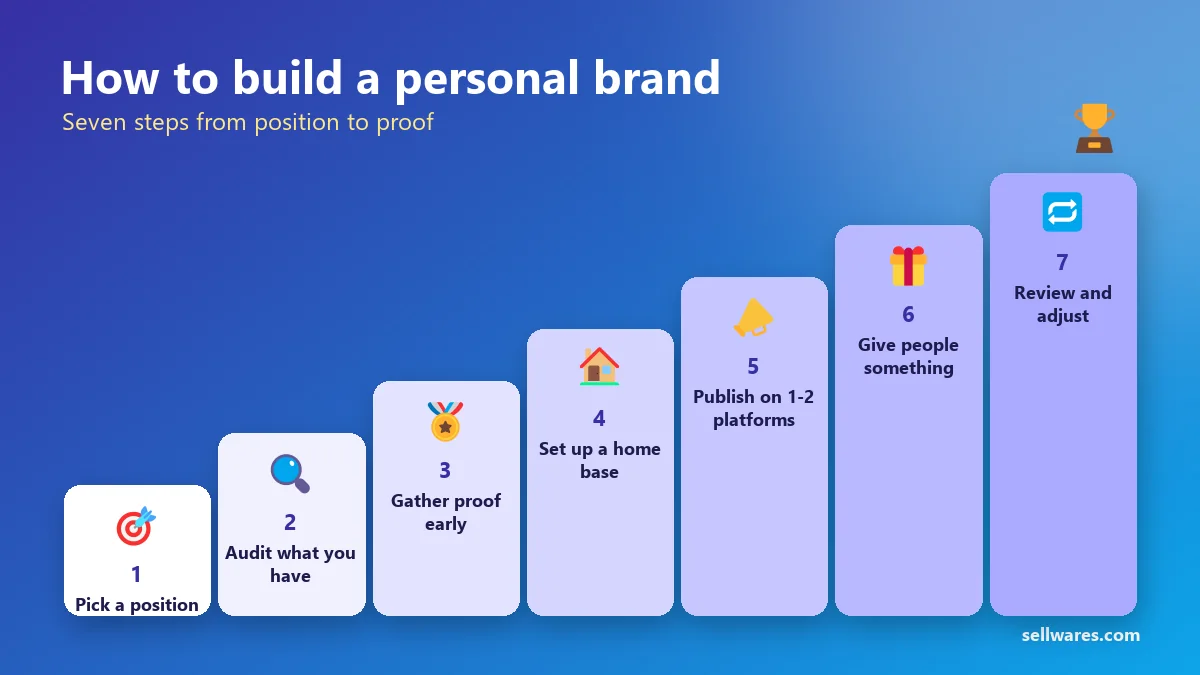
How to build your personal brand, step by step
1. Choose one position
Building a personal brand starts before you post anything. Decide what you want to be known for in one sentence. The Art of Branding newsletter, which ranks first for this search, calls it a positioning problem, not a content problem.
A useful test: could a stranger explain what you do after seeing three of your posts? If not, the position is too wide. "Fitness" is wide. "Strength training for women over 50" is a position.
Ask yourself three questions:
- Who exactly do I help? Name the group, not "everyone".
- What change do I help with? A skill, a result or a decision.
- What is my angle? Your background, method or opinion that others in the field do not share.
2. Audit what you already have
Harvard's guide suggests listing your credentials, your network and your experience, then spotting the gaps. Write down every job, project, course and side project. Circle the ones that support your position. Those become your first stories.
3. Gather proof before you need it
People trust what they can check. Save screenshots of results, before-and-after work, kind messages and finished projects. Ask permission before you share anything that names a client. Proof beats adjectives: "redesigned 12 menus for local cafes" says more than "passionate designer".
4. Set up your home base
Social platforms change their rules, reach and features. Your followers there are rented attention. A home base is the place you own, where your best work, your offer and your email sign-up live. More on this below, because it is the step most guides skip.
5. Publish on one or two platforms
Pick the platform where your people already spend time. Then publish at a pace you can hold for years, not weeks. Return to the same position from new angles: a story, a mistake, a tutorial, an opinion.
6. Give people something to take
A brand grows faster when people can act on it. Offer a free checklist in exchange for an email, a low-priced template, or a short call. If you plan to sell, our guide to selling digital products covers formats and pricing.
7. Review and adjust
Every three to six months, ask a few trusted people how they would describe you. If their answer matches your statement, keep going. If not, sharpen the angle.
How to write a personal brand statement
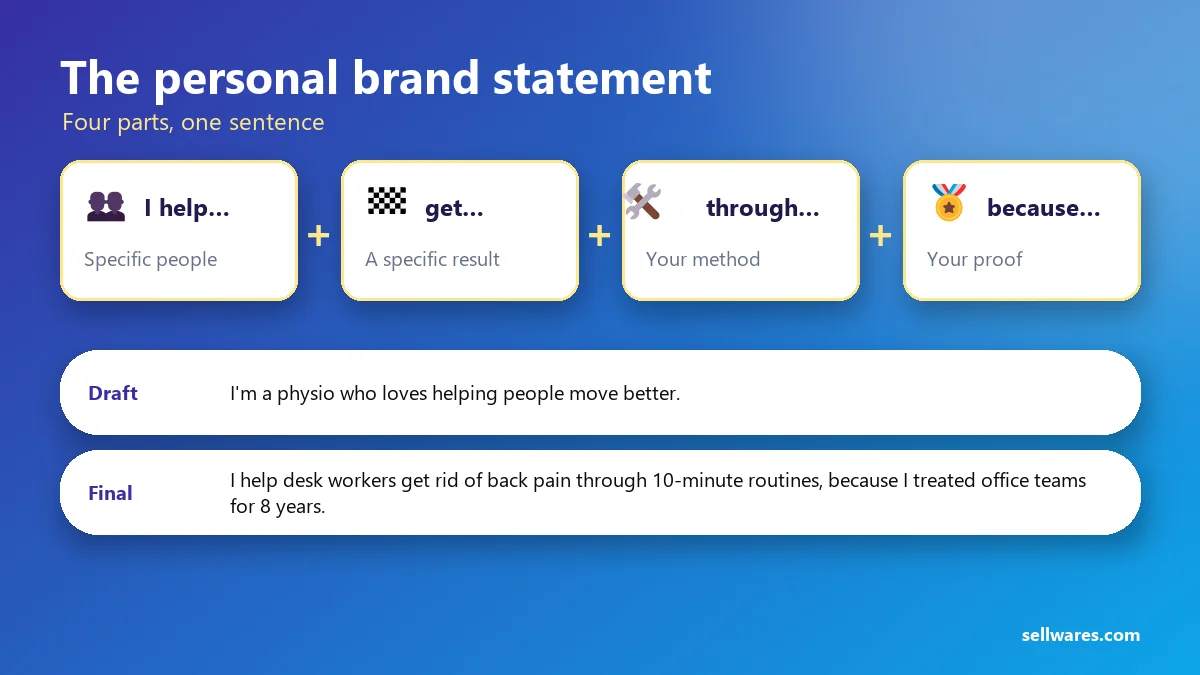
What is a personal brand statement? It is one sentence that says who you help, with what, and why you. It goes in your bio, your About page and the top of your home base.
Use this formula:
I help [specific people] do [specific result] through [your method or angle], because [your proof].
A worked example
Take a made-up physiotherapist, Sam, who wants clients beyond the local clinic.
- First draft: "I'm a physio who loves helping people move better." Clear, but anyone could say it.
- Sharper: "I help desk workers fix back pain with 10-minute routines."
- Final: "I help desk workers get rid of nagging back pain through 10-minute daily routines, because I treated office teams for eight years."
The final version names the people, the result, the method and the proof. Sam can now judge every post idea against it. A video about marathon training? Off-brand. A stretch you can do in a meeting? On-brand.
Personal brand examples (and what they have in common)
These personal brand examples are well-known people. The facts below come from their own websites, read on 8 November 2026.
| Person | Known for | Proof people can check | Home base |
|---|---|---|---|
| James Clear | Habits and small improvements | His About page says Atomic Habits has sold more than 30 million copies | JamesClear.com and the weekly 3-2-1 newsletter |
| Marie Kondo | The KonMari tidying method | Her site says her first book sold more than 14 million copies in 44 languages | KonMari.com, with a consultant program |
| Dan Koe | Writing and one-person businesses | Two free letters a week and a book, The Art of Focus | TheDanKoe.com, with a newsletter |
Three patterns repeat:
- One idea, said for years. Clear writes about habits and decisions. Kondo started her tidying business as a university student in Tokyo, her site says, and still teaches the same method.
- Proof you can count. Books, a method with a name, a list of clients.
- A home they own. Each one sends people to their own site and email list, not only to a social profile.
Your version will be smaller, and that is fine. The same three patterns work at 300 followers.
The home base: the part most guides skip
Here is the gap in the top results. Most pages tell you to post and network. Few explain where all that attention should land.
A home base is one address you control. It should do four jobs:
- Say who you are with your personal brand statement at the top.
- Show proof: your best three pieces of work, a result or a short case study.
- Collect emails, usually with a free guide, so you can reach people without an algorithm.
- Offer one next step: a product, a booking or a membership.
You do not need a full website on day one. A link in bio page does all four jobs and fits in every social bio. On Sellwares that page is free, and visitors can buy or book without leaving it. Later you can move it to your own domain.

Photo: Dámaris Azócar on Unsplash
How to build a personal brand on social media
Social media is where people find you. These habits keep your profile tied to your position:
- Same name, photo and one-line statement on every profile, so people recognize you across apps.
- Three content pillars that all point to your position, for Sam: desk stretches, posture myths, client stories.
- Teach, then interpret. Tutorials get saves. Your opinion on why something works is what people remember you by.
- End posts with one action: follow, reply or visit your bio link.
If your bio link is on TikTok, our guide on adding a link to your TikTok bio shows the steps. Growing an audience on purpose is covered in how to become an influencer.
How to create a personal brand online without burning out
How to develop a personal brand that lasts? Make it small enough to keep. Common traps:
- Too many topics. Five topics means nobody remembers any of them.
- Copying a big creator's style. You get their look without their reasons.
- All rented land. One platform change can erase your reach overnight.
- Hiding the offer. People cannot hire or buy from you if they never see how.
- Quitting after a quiet month. Brands build slowly. Plan in years.
What we found in the top results
We read Google's results for "how to build a personal brand" on 8 November 2026, with Ahrefs data from the same day:
- A Substack essay ranks first, a Reddit thread from r/Entrepreneur second and Harvard Business School Online third. Reddit refused our automated read, so we could not review that thread.
- Linking websites are few. In Ahrefs' top 10, a Medium post at #4 has 1 linking website and Babson College at #5 has none. The strongest page, Hinge Marketing at #7, has 103.
- Google's AI Overview splits the job into positioning, message and platforms, and tells readers to own a digital home.
- The gap: the top three explain the thinking well, but none gives a brand statement formula with a worked example or explains what the home base should contain.
Start with one sentence and one page
Write your statement today, then build the page people land on. Put your proof, a free guide and one offer on it, and link it everywhere you post. When you are ready, start a free store and turn that page into your home base.
Questions
What is personal branding in simple words?
Personal branding is shaping what people think of when they hear your name. You pick what you want to be known for and then show it through your work, your posts and how you treat people. Everyone has a reputation already; branding makes it deliberate.
How long does it take to build a personal brand?
There is no fixed timeline. The top-ranking guides agree it builds slowly, over years rather than weeks. Plan a pace you can keep, and judge progress by whether people describe you the way your statement does.
Do I need a website for my personal brand?
You need one place you control, but it does not have to be a full website at first. A link in bio page can show who you are, your proof, an email sign-up and one offer. You can move to your own domain later.
How do I write a personal brand statement?
Use one sentence: I help [specific people] do [specific result] through [your method], because [your proof]. Name a real group, a result they want and something you have done that backs it up. Then test every post idea against it.
Can you build a personal brand without showing your face?
Yes. Your position, your proof and a consistent voice matter more than your face. Many people build a brand through writing, illustrations, screen recordings or a newsletter. What counts is that people link one clear idea to your name.
Sources
Related
 Guide10 min · 10 stepsBundle Pricing: Types, Formula and How to Set It UpBundle pricing explained: the four types, a simple formula with real numbers, brand examples, the legal question, and how to build a bundle step by step.
 Janie BrooksFollow the guide →
 Free Link in Bio Store With 0% FeesA free link in bio that sells: links, products, bookings and email sign-ups on one page, with 0% transaction fees and…Janie BrooksTake a look →
 BlogPinterest business account · 7 min readPinterest Business Account: Set Up, Claim, First PinsPinterest business account guide: is it free, business vs personal, create or convert on desktop and phone, claim your…
 Oliver BennettRead the post →
 BlogBecome influencer · 6 min readHow to Become an Influencer and Actually Get PaidHow to become an influencer and get paid: pick a niche and platform, build trust, collect emails, and earn from brand…Oliver BennettRead the post →
 BlogUGC become · 6 min readHow to Become a UGC Creator (No Followers Needed)How to become a UGC creator with no followers: pick a niche, film sample videos on your phone, build a portfolio page…Oliver BennettRead the post →