How to Become an Influencer and Actually Get Paid
How to become an influencer and get paid: pick a niche and platform, build trust, collect emails, and earn from brand deals, affiliates and products.

Most advice on how to become an influencer stops at "post consistently". That gets you views. It does not get you paid. To become an influencer you need two things: an audience that trusts you on one topic, and more than one way to turn that trust into income. Brand deals are only one of them. Your own products, sold from a link in bio page, are the one you control.

Photo: bruce mars on Unsplash
We reviewed the pages Google ranks first for this search on 30 October 2026. Course platforms and universities hold the top spots, and a small creator blog with 7 linking websites ranks #6. They cover the growth part well. The money part gets a paragraph at the end. Here it gets equal weight.
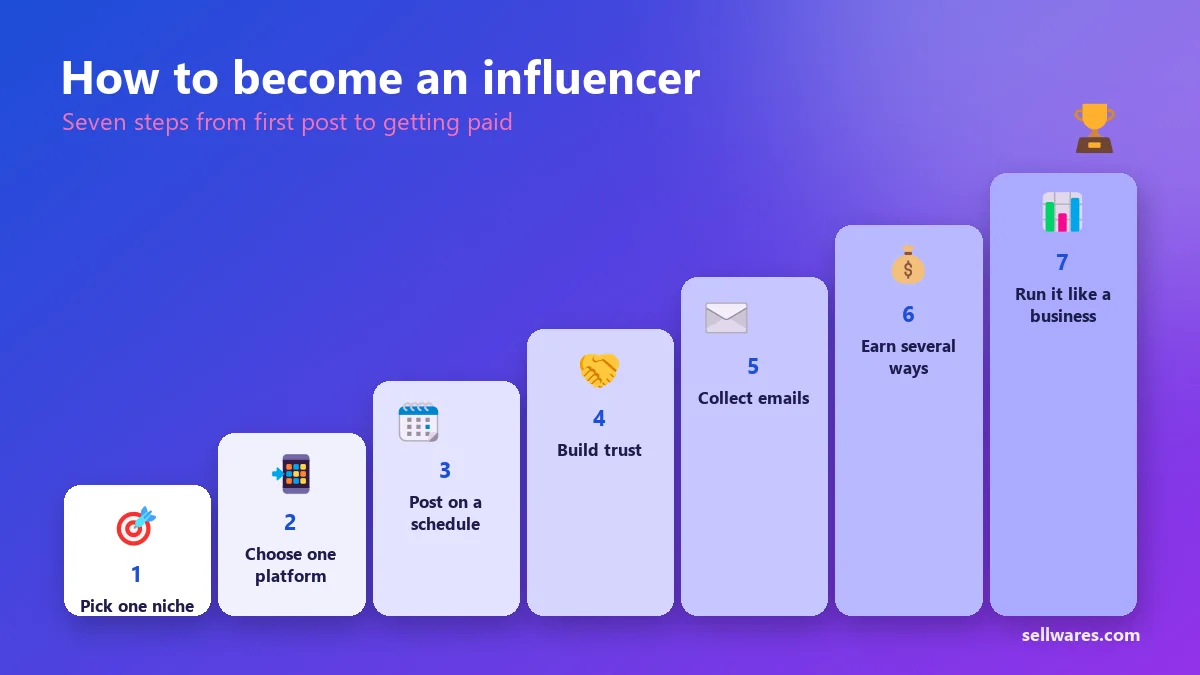
How to become an influencer: the short answer
- Pick one niche you can talk about for years.
- Choose one main platform and learn how it rewards content.
- Post on a schedule you can keep for 12 months.
- Build trust with useful, honest content and replies.
- Collect emails so you own a way to reach your audience.
- Earn from brand deals, affiliate links and your own products.
- Treat it like a business: track, price, disclose and improve.
Step 1: Pick one niche
An influencer is someone people trust on a topic. "Lifestyle" is too broad to trust anyone on. "Budget travel with kids", "strength training after 40" or "plant care for small flats" are niches people follow for a reason.
Choose a niche at the overlap of three things: what you know, what you enjoy, and what people spend money on. The last one matters more than it sounds. A niche with products, tools and services attached has brands that want to reach it and buyers who will pay for help.
Step 2: Choose one main platform
Each platform rewards different content:
- TikTok: fast discovery, short vertical video, trends and hooks. Good for growing from zero.
- Instagram: Reels for reach, stories and posts for trust with existing followers.
- YouTube: longer videos that stay searchable for years; Shorts for discovery.
- LinkedIn: professional and business niches, text and carousels.
- Pinterest: evergreen traffic for food, home, style and DIY.
Start with one. Reuse your videos elsewhere once the first platform works, but learn one set of rules properly first.

Photo: Faz Islam on Unsplash
Step 3: Post on a schedule you can keep
Growth comes from many good posts, not one viral one. Pick a schedule you can keep for a year, such as three short videos a week, and keep it.
Make it easier with content pillars: three or four recurring formats people come back for. For a budget-travel creator that might be "trip costs, itemised", "one-day itineraries", "mistakes I made" and "questions from comments".
Watch your numbers every week. On short video, look at how many viewers stay past the first three seconds and how many watch to the end. Do more of what holds attention.
Step 4: Build trust, not just reach
Followers are not the goal; trust is. A creator with 8,000 engaged followers can earn more than one with 200,000 passive ones, because people act on their advice.
- Reply to comments and messages, especially early on.
- Show your real results and mistakes, not only highlights.
- Recommend only what you would buy yourself.
- Answer questions in full videos. Each answer is content and proof that you help.
Step 5: Collect emails from day one
Platforms change their rules and reach without warning. Email is the one channel you own. Offer something free and useful, such as a checklist, a mini guide or a template, in exchange for an email address.
Put that offer on your link in bio page, so every profile visit can turn into a subscriber. Then send a short, useful email on a schedule, such as every two weeks.
Step 6: How influencers get paid
Here are the main income streams, from least to most control:
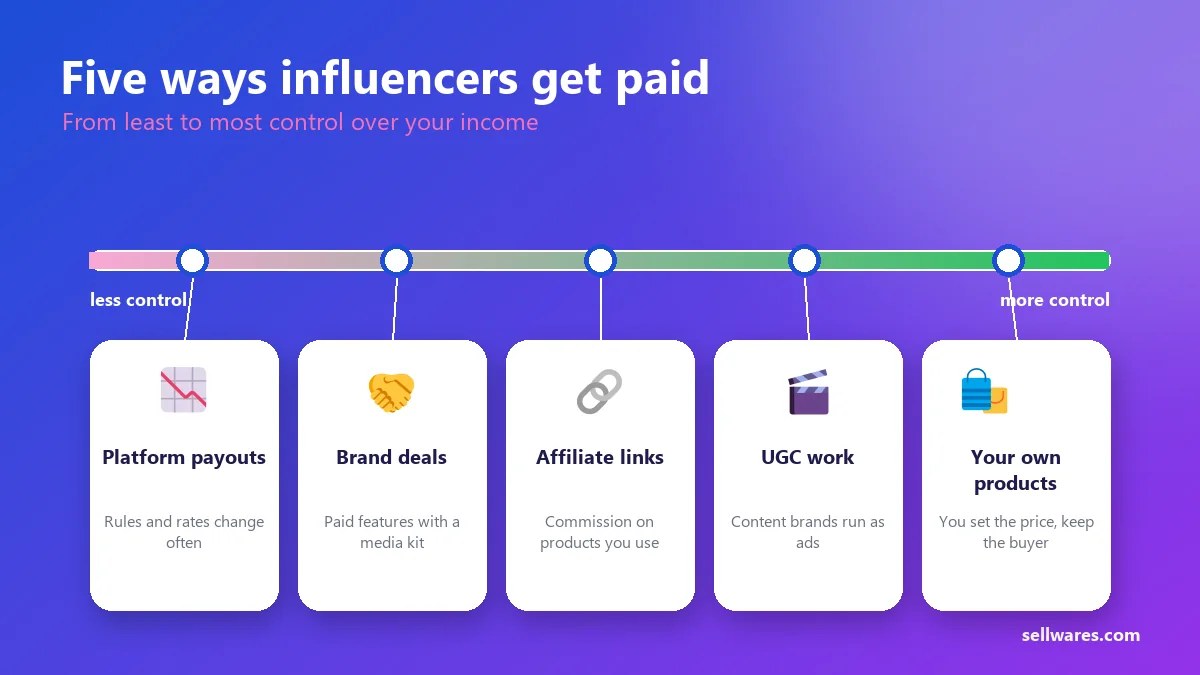
- Platform payouts. Creator funds and ad revenue sharing on some platforms. Useful, but rules and rates change often and you control none of them.
- Brand deals. Brands pay you to feature their product. Prices depend on niche, engagement and what you deliver. Use a media kit with your audience numbers and past results.
- Affiliate links. You earn a commission when followers buy through your link. Good for honest recommendations of products you use.
- UGC work. You make content for brands to use in their own ads, without posting it. It needs no big following; see what a UGC creator is.
- Your own products. Guides, templates, presets, courses, coaching calls and memberships. You set the price and keep the customer.
The last one is the most stable, because no brand budget or algorithm decides it. On Sellwares you can sell digital products and calls from your link in bio page with a 0% transaction fee, so a product with 200 buyers a month pays you for all 200.
How many followers do you need to get paid?
There is no official number for brand deals or your own products. Brands hire creators of every size, and a small, engaged audience in a clear niche can be enough to start, because trust matters more than size. Some platform programmes do have minimums; TikTok, for example, only shows the website link on personal profiles from 1,000 followers. Our guide on how to add a link to your TikTok bio covers the workarounds.
Step 7: Treat it like a business
- Disclose paid relationships. In the US, the FTC requires influencers to make clear when a brand paid them or gave them free products. Its guide for influencers explains how.
- Use contracts for every brand deal: what you deliver, when, usage rights and payment terms.
- Track your income by stream, so you know what to grow.
- Set rates, and raise them as your results improve.
- Keep records for taxes. Influencer income is taxable in most countries.
Mistakes that slow new influencers down
- Chasing every trend. Trends bring views from people who do not care about your niche. Use them only when they fit.
- Buying followers. Fake followers lower your engagement rate, and brands check it.
- Waiting for brands to call. Pitch brands you already use, with a short media kit and your best results.
- Relying on one platform. One rule change can cut your reach overnight. Email and your own page protect you.
- Selling too late. A small product early teaches you what your audience will pay for, long before you are "big enough".
- Saying yes to every deal. Promoting things you would not use costs trust, and trust is the asset.
Influencer or content creator: which are you?
The words overlap. A content creator makes content; an influencer is a content creator whose recommendations move people to act. Many creators prefer the first label, and brands increasingly do too. What matters is not the title but whether your audience trusts your advice enough to follow it.
What we found in the top results
We reviewed the pages Google ranks first for "how to become an influencer" on 30 October 2026:
- Education sites dominate. Course platforms and universities rank at the top with general advice on growing an audience.
- A tiny creator blog ranks #6. A site with a Domain Rating of 2 and 7 linking websites holds its own on page one. Practical, first-hand tips compete with big brands here.
- Income gets the least space. Most pages list "brand deals" and stop. Few show the other income streams or how to own your audience.
Start building today
Pick your niche, post your first three videos this week and set up a page that collects emails and sells your first small product. Create your free link in bio store and paste it into your profiles.
Questions
Do influencers get paid?
Yes, through brand deals, affiliate commissions, platform payouts, UGC work and their own products. Income varies widely with niche, engagement and how many streams they use.
How many followers do you need to be an influencer?
There is no official number. Brands hire creators of every size, and a small, engaged audience in a clear niche can be enough to start earning.
How do I start as an influencer?
Pick one niche and one platform, post three times a week for a year, reply to every comment, and set up a page that collects emails from day one.
Do influencers need to disclose sponsored posts?
Yes. In the US the FTC requires influencers to disclose when a brand paid them or gave them free products, in a way followers will notice.
Sources
Related
 BlogUGC become · 6 min readHow to Become a UGC Creator (No Followers Needed)How to become a UGC creator with no followers: pick a niche, film sample videos on your phone, build a portfolio page, set packages and pitch brands.
 Oliver BennettRead the post →
 Free Link in Bio Store With 0% FeesA free link in bio that sells: links, products, bookings and email sign-ups on one page, with 0% transaction fees and…
 Janie BrooksTake a look →
 BlogPersonal brand · 7 min readHow to Build a Personal Brand: 7 Steps and ExamplesHow to build a personal brand in 7 steps: choose a position, write a brand statement, collect proof and set up a home…Oliver BennettRead the post →
 BlogUGC what · 6 min readWhat Is a UGC Creator? Meaning, Pay and SkillsWhat is a UGC creator? The meaning of UGC, what UGC creators make, how they get paid and how the job differs from being…Oliver BennettRead the post →
 Answer5 min readStan Store Review 2026: Is It Legit and Worth It?Stan store review 2026: Creator is $29 a month, Creator Pro $99, 0% transaction fees, no free plan. What you keep on…
 Alexa MorganRead it →