What Is a UGC Creator? Meaning, Pay and Skills
What is a UGC creator? The meaning of UGC, what UGC creators make, how they get paid and how the job differs from being an influencer.

What is a UGC creator? A UGC creator is someone paid by brands to make photos and videos that look like they came from a real customer. UGC stands for user-generated content. The brand owns the result and uses it in its own ads, product pages and social accounts. Unlike an influencer, a UGC creator does not need followers, because the brand is buying the content, not the audience.

Photo: siddharth vyas on Unsplash
That one difference explains most of what follows: how UGC creators get paid, what skills matter and why the work has grown so fast. If you want to try it, many UGC creators send brands a portfolio page from their link in bio. Our step-by-step guide on how to become a UGC creator covers the first brief.
UGC creator meaning, in plain words
Originally, user-generated content meant anything customers posted on their own: a review, an unboxing video, a photo of a product in use. Brands noticed it often sold better than their polished ads, because it felt honest.
Today "UGC" also describes a job. Brands hire people to make content in that same customer style, on purpose and on a brief. The person making it is a UGC creator.
So when someone asks "what is UGC content", the answer has two parts: content made by real customers, and content made in their style by paid creators.
Photo: Sticker it on Unsplash
What does a UGC creator make?
Typical deliverables are short, vertical and filmed on a phone:
- Product reviews: a quick, honest take with a clear result.
- Unboxings: first impressions when the package opens.
- Demos and tutorials: the product in use, step by step.
- Testimonial-style videos: "I tried this for 30 days, here is what happened".
- Hooks: several different first three seconds for the same video, so the brand can test which one stops the scroll.
- Photos: the product in a real home, on a real person, in daylight.
- Voice-overs and screen recordings for apps and software.
The brand usually asks for the edited video, sometimes the raw clips as well, so its own team can recut them.
UGC creator vs influencer
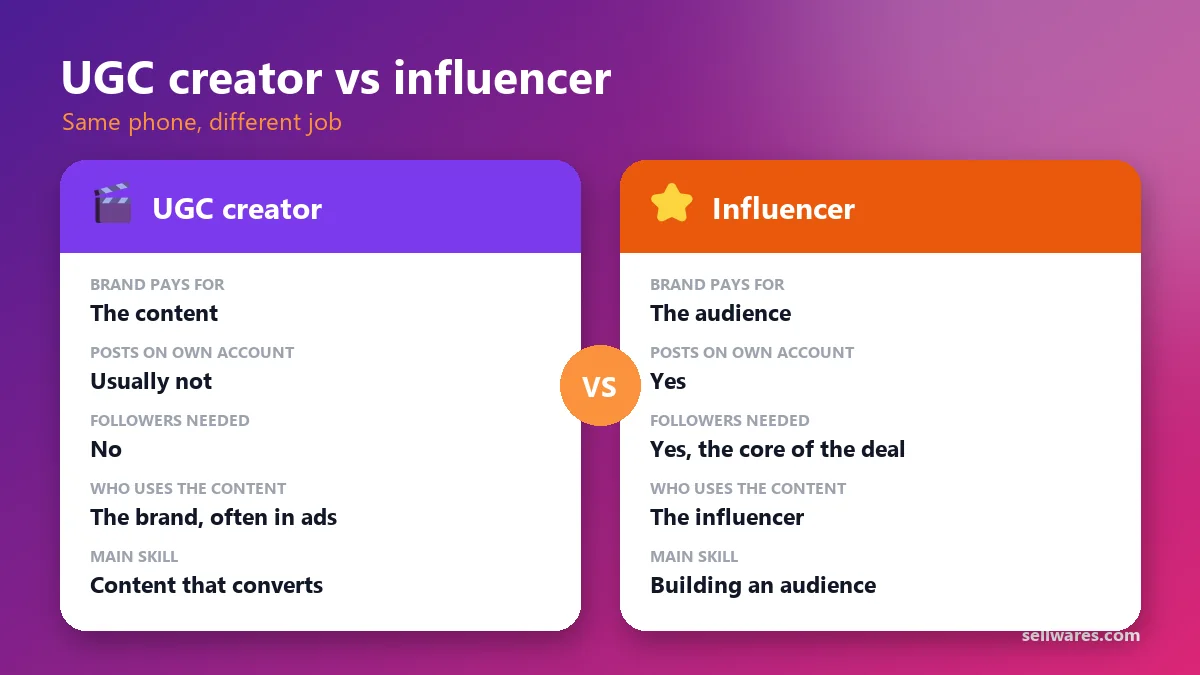
This is where most of the confusion sits. The two jobs overlap, but they are paid for different things.
| UGC creator | Influencer | |
|---|---|---|
| Brand pays for | The content | Access to the audience |
| Posts on own account | Usually not | Yes |
| Followers needed | No | Yes, the core of the deal |
| Who uses the content | The brand, often in paid ads | The influencer, on their feed |
| Typical income | Per video or package | Per post, campaign or affiliate sale |
| Main skill | Making content that converts | Building and keeping an audience |
Some people do both. An influencer can sell UGC too, and a UGC creator who posts their own videos may grow into an influencer. If you want the audience route, you build your own following first and sell access to it later.
Do UGC creators get paid?
Yes. UGC creators are paid per video or per package, by the brands that hire them or through UGC platforms that connect both sides. Pay varies widely with experience, niche and what the brand may do with the video.
The biggest factor is usage rights. A video the brand posts once on its own account is worth less than one it runs as a paid ad for six months. Extra hooks, raw footage and whitelisting (running ads from the creator's own account) are usually priced on top.
If a brand pays you through PayPal goods and services, the fee comes out of what you receive: see PayPal's goods and services fee and agree who covers it before you start.
Instead of guessing a number, new creators often start with a simple package, such as one video with three hooks, and raise prices after their first few briefs and testimonials.
What do you need to become a UGC creator?
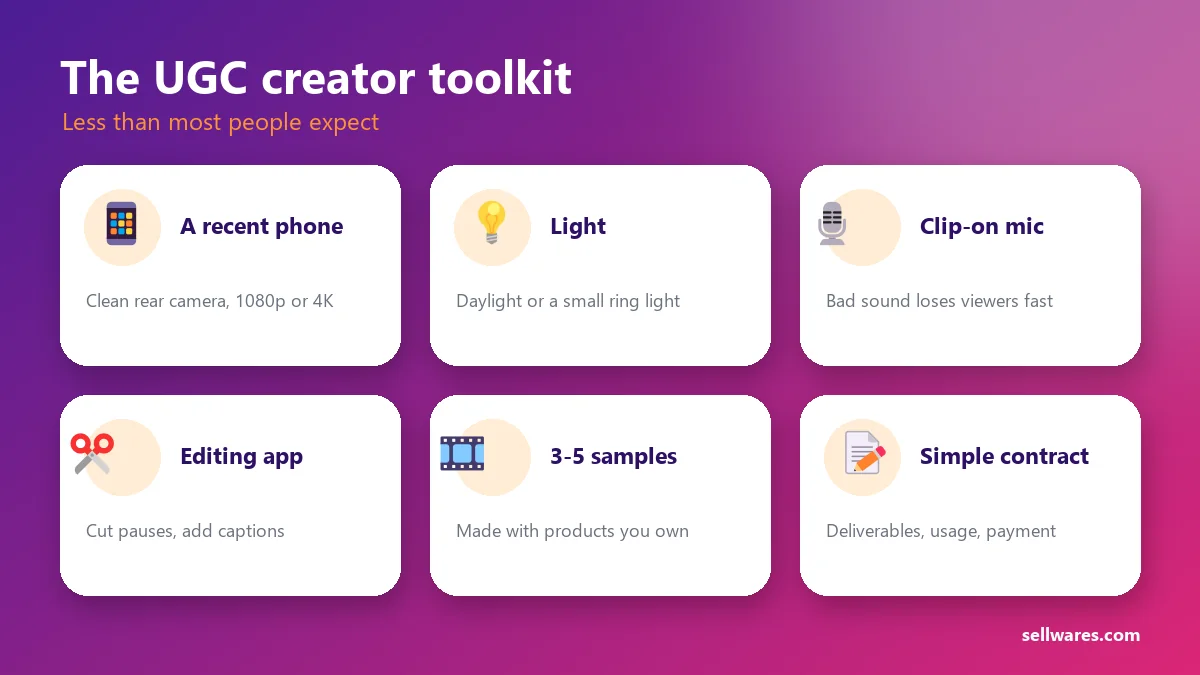
Less than most people expect:
- A recent phone with a clean rear camera.
- Daylight or a small ring light, and a clip-on microphone.
- An editing app such as CapCut.
- 3 to 5 sample videos made with products you already own.
- A portfolio page with your best videos and a way to contact you.
- A simple contract covering deliverables, revisions, usage and payment.
The skill that matters most is not acting. It is understanding why people buy: naming the problem, showing the product solving it, and saying it in the first three seconds.
Is UGC still worth it?
It is more competitive than a few years ago, because more people know about it. It is also more in demand, because short video dominates ads on TikTok, Instagram and YouTube, and brands need a steady stream of new versions to keep ads fresh.
What separates creators who get repeat work:
- A niche, so brands see you as their customer.
- Fast, professional replies and on-time delivery.
- Understanding ads: hooks, clear calls to action, captions.
- A tidy portfolio that loads quickly on a phone.
Treat it like a small business, not a lottery, and it can be a steady income or a strong side income.
Examples of UGC in real ads
You have almost certainly seen UGC today without noticing. Common examples:
- A skincare brand's TikTok ad that opens with a creator saying "I have tried every cleanser for dry skin" before showing the product.
- An app's Instagram ad with a screen recording and a voice-over walking through one feature.
- A food delivery ad filmed in a real kitchen, with the box opened on the counter.
- Product page videos on online shops, showing the item in someone's hands instead of on a white background.
- Before-and-after photos for cleaning products, haircare or home goods.
Each one is built to feel like advice from a friend. That is the whole point, and why brands keep paying for it.
Where do UGC creators find work?
Most creators combine three routes:
- UGC platforms that list briefs from brands and handle payment.
- Direct pitches to brands they already buy from, with a portfolio link.
- Repeat clients and referrals, which become the main source once the first brands are happy.
A portfolio page in your bio helps with all three, because brands that find you on social media can see your work in one tap.
Is UGC content legal?
Yes, when the rights are agreed in writing. The contract should say what the brand may do with your content, where and for how long. If you also post sponsored content on your own account, US rules require you to disclose the relationship; the FTC's guide for influencers explains when and how.
What we found in the top results
We reviewed the pages Google ranks first for "what is a UGC creator" on 30 October 2026:
- An Instagram post ranks #2. A short creator explainer beats long articles, which shows how much people want plain answers.
- An agency's creator sign-up page sits on page one with 25 linking websites, though it is not an explanation at all.
- Few pages compare UGC and influencing side by side, although that difference is the reason the job exists.
From UGC creator to your own products
Brand work depends on brands. Many UGC creators add income they control, such as a guide for new creators, a hook template pack or paid portfolio reviews. You can sell digital products from the same page as your portfolio, with a 0% transaction fee.
Build your free portfolio page and start with three sample videos.
Questions
Do UGC creators get paid?
Yes. They are paid per video or per package by brands or through UGC platforms. Usage rights, extra hooks, raw footage and whitelisting usually cost extra.
What do you need to become a UGC creator?
A recent phone, good light, a clip-on microphone, an editing app, 3 to 5 sample videos, a portfolio page and a simple contract.
Is UGC still a thing in 2026?
Yes. Short video dominates ads on TikTok, Instagram and YouTube, and brands need a steady stream of new versions to keep ads fresh.
Is UGC content legal?
Yes, when the rights are agreed in writing: what the brand may do with the content, where and for how long. Sponsored posts on your own account also need a clear disclosure.
What is the difference between UGC and influencer marketing?
Influencer marketing pays for access to an audience; the influencer posts to their followers. UGC pays for the content itself; the brand posts it.
Sources
Related
 Comparison4 min readThinkific vs Teachable: Prices, Fees and Limits (2026)Thinkific vs Teachable on 2026 prices, the 7.5% Starter fee, product limits and features, with when each plan pays off for course creators.
 Alexa MorganRead it →
 Sell Digital Products Online with 0% FeesSell ebooks, templates, presets, music and more from your own store. Instant delivery, 0% transaction fee, paid…
 Janie BrooksTake a look →
 Free Link in Bio Store With 0% FeesA free link in bio that sells: links, products, bookings and email sign-ups on one page, with 0% transaction fees and…Janie BrooksTake a look →
 BlogLife coach · 6 min readWhat Is a Life Coach? What They Do, Cost and EarnWhat is a life coach? What they do in a session, how coaching differs from therapy, what it costs ($234 an hour on…
 Oliver BennettRead the post →
 BlogMoney online beginners · 7 min readHow to Make Money Online for Beginners: 9 WaysHow to make money online for beginners: 9 methods ranked by time to first dollar, start cost and skill, plus the FTC's…Oliver BennettRead the post →