What Is a Life Coach? What They Do, Cost and Earn
What is a life coach? What they do in a session, how coaching differs from therapy, what it costs ($234 an hour on average) and how coaches earn.

What is a life coach? A life coach is a trained professional who helps you set goals, decide what to do next and follow through, through a series of structured conversations. They work on your present and future, not on healing the past, which is what separates coaching from therapy. Many coaches now run their whole practice online and sell their sessions next to guides and courses.

Photo: Christina @ wocintechchat.com on Unsplash
This guide explains what a life coach does, what they cost, how they differ from a therapist, and how coaches earn a living. We wrote it after reviewing the pages Google ranks first for this question on 30 October 2026: a Reddit thread, a coach-training school and a dictionary entry. Each covers one part. We put the parts together.
What a life coach does
A life coach helps you get from where you are to where you want to be. The International Coaching Federation (ICF), the largest professional body for coaches, describes coaching as a partnership that helps clients reach their personal and professional potential through a thought-provoking process.
In practice, a coach will:
- Clarify your goal. Many clients start with "I feel stuck". A coach turns that into a goal you can measure.
- Ask questions instead of giving answers. The plan you make yourself is the one you keep.
- Build a plan with you, broken into steps with dates.
- Hold you accountable. Regular sessions mean someone checks whether you did what you said.
- Help you notice patterns that keep tripping you up, such as saying yes to everything.

Photo: Amy Hirschi on Unsplash
What does a life coach do in a session?
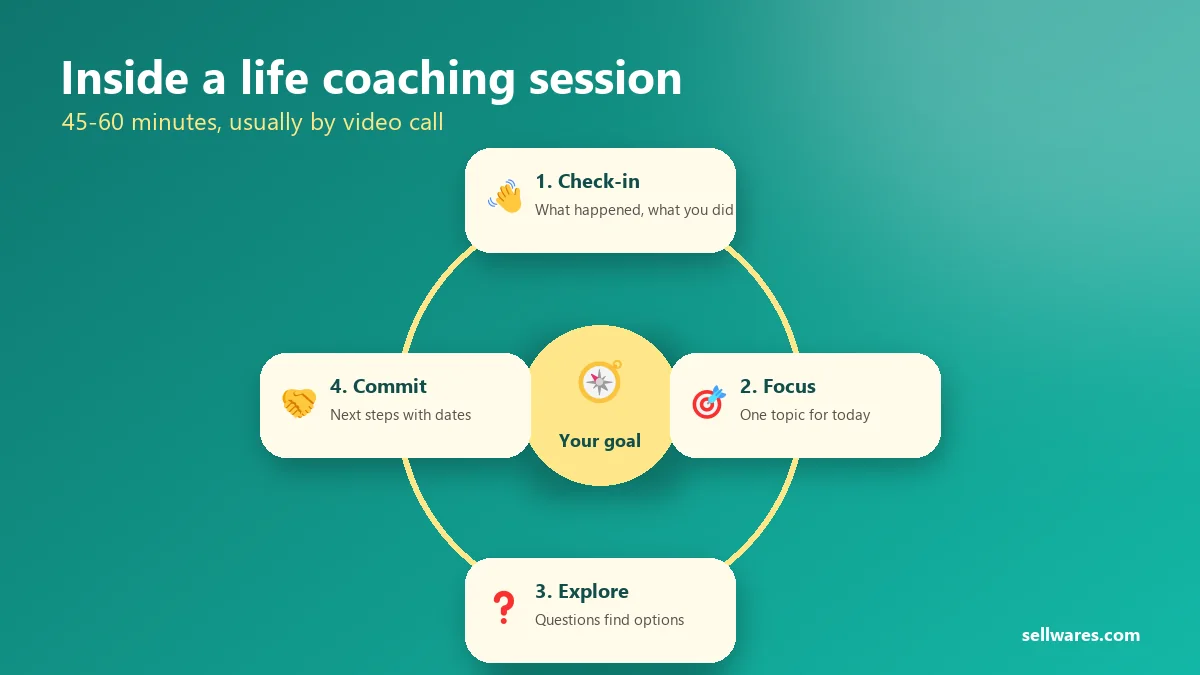
A typical session lasts 45 to 60 minutes, usually by video call. It often follows the same shape:
- Check-in: what happened since last time, and what you did on your plan.
- Focus: one topic for today.
- Exploration: the coach asks questions to find options and obstacles.
- Commitment: you choose the next steps and when you will do them.
Most coaching runs as a package of sessions over three to six months, because change takes repetition.
Types of life coaches
"Life coach" is a broad title. Many coaches specialise:
- Career coaches for job changes, promotions and starting a business.
- Health and wellness coaches for habits like sleep, food and exercise.
- Relationship coaches for dating, marriage and communication.
- Executive and leadership coaches for managers and founders.
- Business coaches for owners growing a company.
- Confidence and mindset coaches for self-belief and decision-making.
A specialist usually helps faster than a generalist, because they have seen your exact problem many times.
Life coach vs therapist: what is the difference?
This is the question people ask most after "what is a life coach". The short answer: therapy treats mental health conditions; coaching helps healthy people reach goals.
| Life coach | Therapist | |
|---|---|---|
| Focus | Goals, the present and the future | Mental health, the past and the present |
| Treats conditions such as depression or anxiety | No | Yes |
| Licence required | No, the field is unregulated | Yes, a state or national licence |
| Typical work | Plans, accountability, decisions | Diagnosis, treatment, healing |
| Covered by health insurance | Rarely | Often |
A good coach refers you to a therapist when a problem is clinical. If you are dealing with depression, trauma or anxiety that affects daily life, start with a licensed professional.
How much does a life coach cost?
Prices vary with the coach's niche, experience and format. According to a summary of the ICF's 2025 Global Coaching Study published by Psychology.org, life coaches charge an average of $234 for a one-hour session.
You will see a wide range in practice:
- Group coaching costs less per person, because several clients share each session.
- Packages of 6 to 12 sessions are common and usually cheaper per session than paying one at a time.
- Executive coaches often charge more, and companies frequently pay for them.
Before you pay, ask for a short free call to check the fit. A coach you trust and talk to easily is worth more than one with a long list of certificates.
Do life coaches need a certification?
No law requires it in most countries; the field is unregulated. Many coaches still train and certify, often through programmes accredited by the ICF, because it teaches proven methods and an ethics code. When you choose a coach, ask about their training, their niche and results they have helped clients reach.
How do life coaches make money?
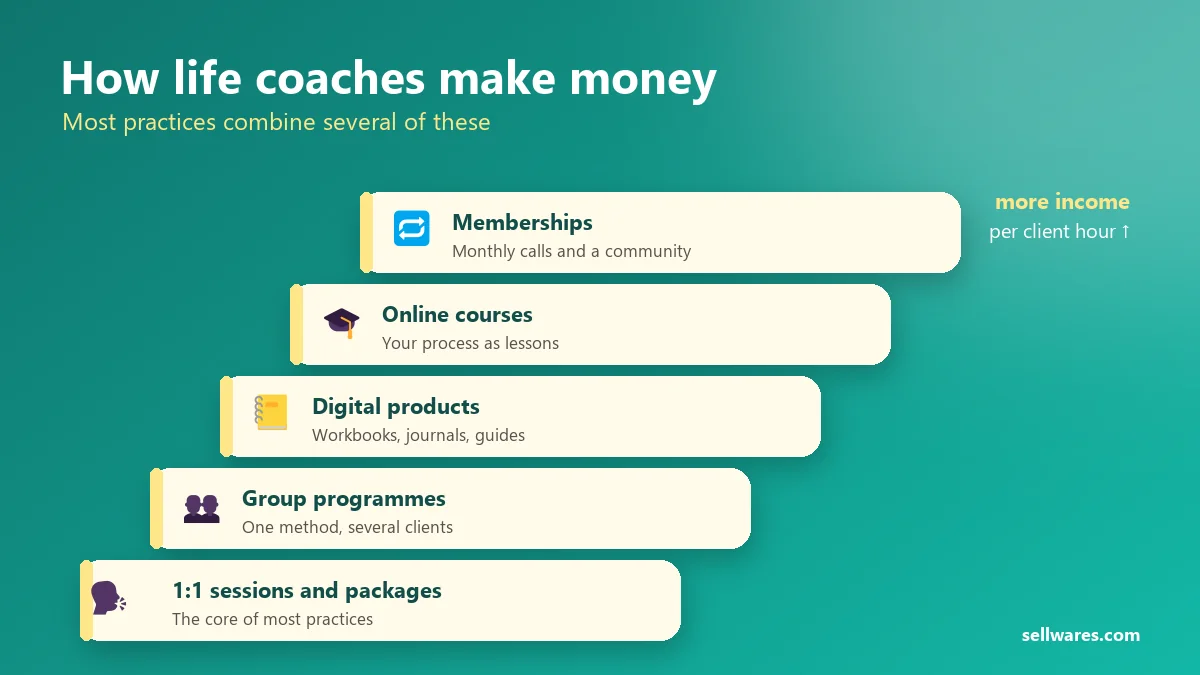
This is where many new coaches struggle. Coaching is a business, and the coaching is only part of it. Most coaches earn from a mix of:
- 1:1 sessions and packages, the core of most practices.
- Group programmes that teach one method to several clients at once.
- Digital products such as workbooks, journals and short guides. They earn while you sleep and introduce new people to your method.
- Online courses that turn your process into video lessons.
- Memberships with monthly calls and a community.
The practical part is taking bookings and payments without a pile of tools. On Sellwares a coach can sell a 1:1 call next to their downloads: the client picks a free slot, pays, and both get a Zoom or Google Meet link. The Bio for a calendar template on our link in bio page puts your free times first, which suits coaches who work from Instagram or LinkedIn.
When is a life coach worth it?
A coach helps most when you know something should change but keep putting it off. Common reasons people hire one:
- A career decision: staying, leaving, asking for more, or starting something of your own.
- A goal that keeps slipping, such as a business launch, a fitness target or a book.
- A transition: a move, a new role, becoming a parent, retirement.
- Too many options and no clear priority.
A coach helps less when you want someone to tell you exactly what to do, or when the real need is treatment for a mental health condition. In the first case a consultant or mentor fits better; in the second, a therapist.
What to expect from the first sessions
The first session is usually about the goal and your starting point. Expect questions about what you want, what you have tried and what gets in the way. By the second or third session you should have a plan with dates and a clear way to measure progress. If you do not, say so; a good coach adjusts.
How to find a good life coach
- Define the goal first. "Change careers within a year" is easier to match than "feel better".
- Look for a specialist in that goal.
- Read reviews from real clients and look for specific results.
- Book a discovery call. Notice whether they listen more than they talk.
- Agree on the structure: number of sessions, price, cancellation rules and how you will measure progress.
What we found in the top results
We reviewed the pages Google ranks first for "what is a life coach" on 30 October 2026:
- A Reddit thread ranks #2. People want plain explanations from people who have hired a coach, not marketing copy.
- Coach-training schools hold several spots. Their pages explain coaching well but are written to sell certification.
- The money side is missing. Few pages explain how coaches earn, although many readers are wondering whether to become one.
Thinking of becoming a coach?
Start with one clear niche, one package and a simple way for clients to book and pay. You can create a free account, set up your first coaching call and share your booking page from your bio the same day.
Questions
What is the average cost for a life coach?
According to a Psychology.org summary of the ICF's 2025 Global Coaching Study, life coaches charge an average of $234 for a one-hour session. Packages and group coaching usually cost less per session.
What is the difference between a life coach and a therapist?
A therapist is licensed to diagnose and treat mental health conditions. A life coach helps healthy people set and reach goals, focusing on the present and future. Coaches should refer clients to a therapist when a problem is clinical.
What is the difference between a life coach and a health coach?
A health coach is a life coach who specialises in habits such as food, sleep and exercise. A general life coach works on any goal, such as a career change or a big decision.
Do life coaches need a certification?
In most countries no law requires one. Many coaches still train through programmes accredited by the International Coaching Federation to learn proven methods and an ethics code.
How long do people work with a life coach?
Most coaching runs as a package of sessions over three to six months, because real change takes repetition and follow-up.