How to Start Writing a Book: First Steps
How to start writing a book: turn your idea into one sentence, pick outline or discovery, set a daily word goal and write chapter one this week.
If you are wondering how to start writing a book, the honest answer is smaller than you fear: pick one idea, write it as one sentence, and write a little every day until a rough first chapter exists. Planning, publishing and selling come later. When the book is done, you can self-publish it or sell digital products like it straight to your readers. This guide covers the first steps for fiction and non-fiction, books about your own life, and the traps that stop most beginners in week one.

Photo: Vladyslav Bahara on Unsplash
You do not need a degree, an agent or a perfect plan. If you keep asking "how do I start writing a book?", the answer below is built for you. You need a starting point and a habit you can keep.
How to start writing a book: the short answer
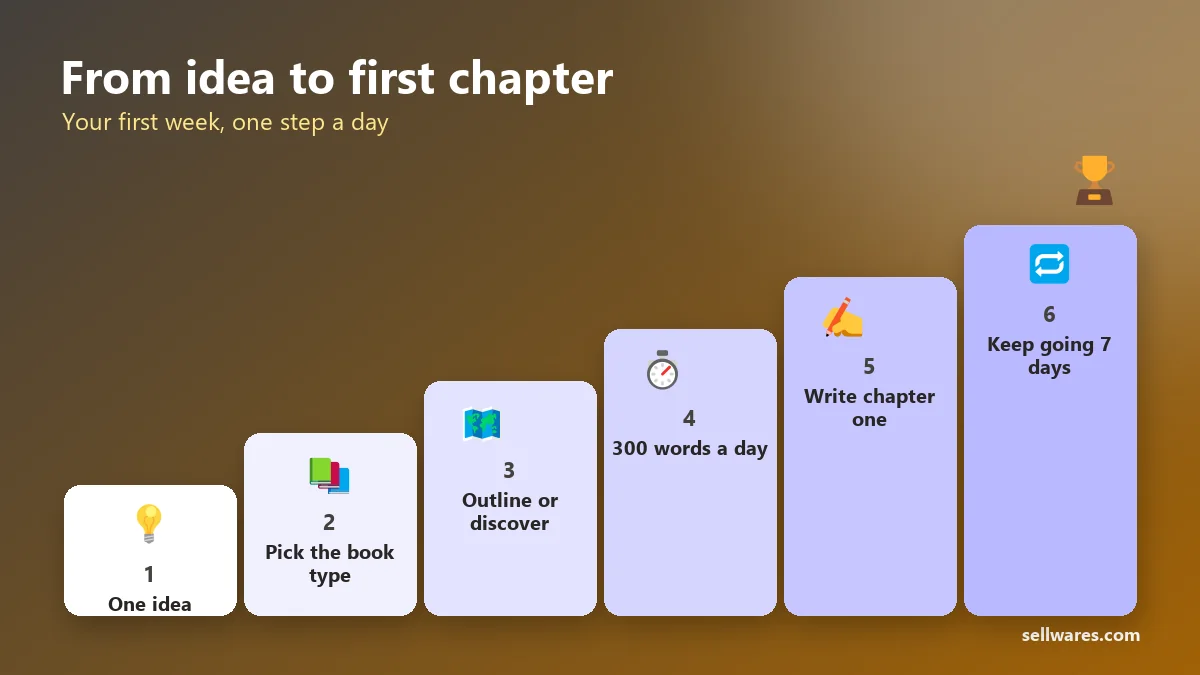
Here is how to start writing a book for beginners, and the best way to start writing a book if you have never finished one:
- Write your idea as one sentence: who it is about, what they want, what stands in the way.
- Decide the kind of book: novel, how-to guide or life story.
- Choose to outline first or to discover the story as you write.
- Set a daily word goal you can hit on a bad day, such as 300 words.
- Pick a fixed time and place to write.
- Write chapter one fast, without editing.
- Keep going for seven days before you judge anything.
Step 1: Turn the idea into one sentence
Most stalled books never had a clear idea. They had a mood, a setting or a topic. A sentence forces a choice.
For fiction, use this shape: A [character] wants [goal], but [obstacle]. For non-fiction, use: This book helps [reader] get [result] without [pain]. If you cannot fill the blanks yet, write ten versions and keep the one that excites you.
Pick a small scope. A first book that tries to hold every idea you have ever had will collapse. One clear story or one clear promise is enough.
Give it a working title
A title makes the project feel real, and you can change it later. If you are stuck, our book title generator gives you a list to react to. Writing fantasy? The fantasy title generator suggests names in that style. Treat both as sparks, not final answers.
Step 2: Decide what kind of book it is
The first steps differ a little by type.
| Book type | Start with | Plan you need | A good first goal |
|---|---|---|---|
| Novel | A character with a problem | Loose: the opening, a midpoint, an ending | Write the first scene |
| How-to or non-fiction | The reader's problem | A table of contents, one step per chapter | Write the chapter you know best |
| Memoir or life story | One period or theme of your life | A list of 10 to 20 key memories | Write one memory in full |
| Short book or guide | One question people ask you | 5 to 10 short chapters | Write the introduction |
Jeff Goins, whose guide ranks on page one, splits book length into 10,000-word steps. He puts a short ebook near 20,000 words and a standard novel at 60,000 to 80,000. You do not need to know your final length on day one. A rough target just helps you plan.
Step 3: Outline or write by discovery
Writers often split into two camps. Plotters plan first. Discovery writers, sometimes called pantsers, start writing and find the story on the page.
If you like a plan
Write a list of chapters, with one line each. For a novel, note the opening, the turning point in the middle and the ending. For non-fiction, put the steps in the order a reader would take them. Reedsy's coach suggests a flexible plan built on cause and effect, where each scene leads to the next with "therefore" or "but".
If you like to discover
Start with the situation and write. Some novelists write the first fifty pages with no outline, then plan once they know the characters. Write the scenes you are excited about, even out of order, and join them later.
Neither way is better. Try one for a week. If you freeze, switch. Many writers end up in the middle: a short list of key moments and freedom between them.
Photo: Markus Winkler on Unsplash
Step 4: Build a daily word habit
This is where books get written. Inspiration shows up after you start, not before.
- Set a small daily goal. Goins suggests about 300 words, roughly a page. Reedsy suggests 500 words in 30 minutes rather than an unrealistic 5,000.
- Write at the same time each day. Early morning and lunch breaks work for many people with jobs.
- Write in the same place. A desk, a library table or a café corner tells your brain it is time to work.
- Plan days off in advance. A planned rest day is not failure. A missed day you did not plan often becomes a missed month.
At 300 words a day, a 20,000-word short book takes about 67 days. A 70,000-word novel takes about eight months. Those numbers are reachable for anyone with half an hour.
Tools to write on a laptop
Use the simplest tool you already own. Google Docs, Word or a plain-text app is enough. Fancy software can wait until you have a draft to organize.
How to start writing a book about your life
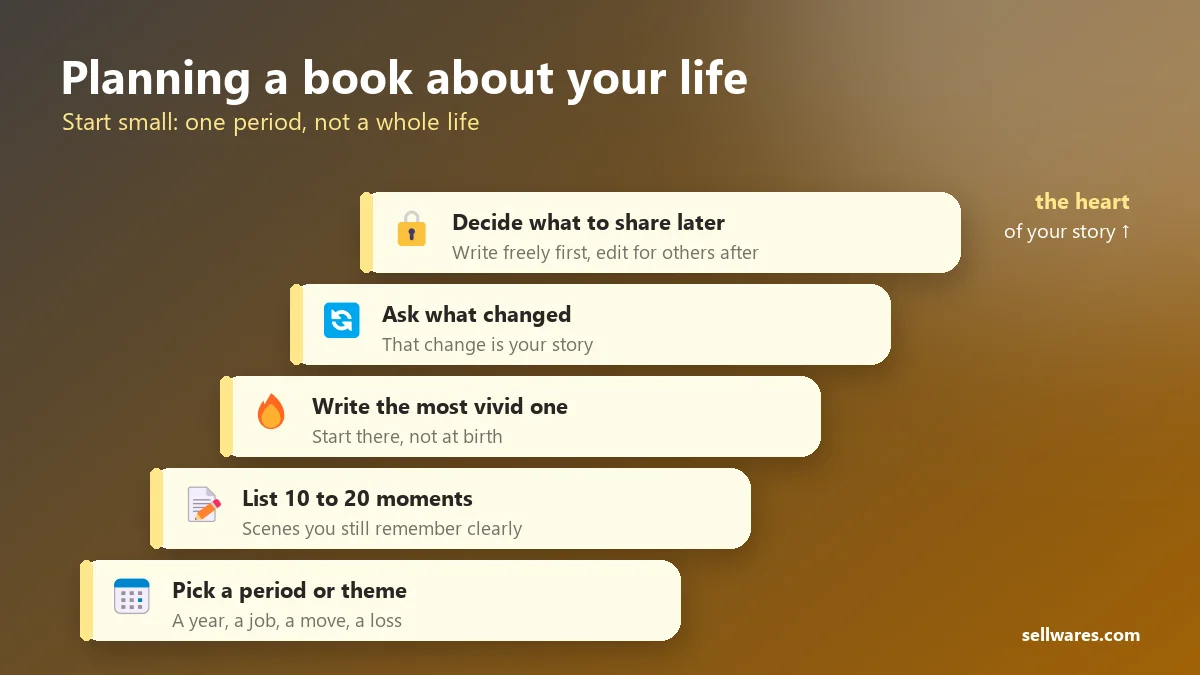
A life story is the most personal book you can write, and the hardest to start. Your whole life is too big. Pick a slice.
- Choose a theme or period. Your first job, raising a child alone, a year abroad, an illness, a business that failed.
- List 10 to 20 moments from that slice, one line each.
- Write the most vivid one first. Use the present details: what you saw, heard and said.
- Ask what changed. A memoir works when the reader sees who you were before and who you became.
- Write the truth, then decide later what to share. Privacy choices belong to the editing stage, not the first draft.
If you want to help readers with what you learned, you can blend memoir and how-to. Each chapter tells a story, then gives the lesson.
How to start writing a book with no experience: traps to avoid
Starting with no experience is normal. These traps cause most quits:
- Editing chapter one forever. Fix: no edits until the full draft exists. Reedsy suggests resting a finished draft for two weeks before you edit.
- Waiting for the perfect first line. Fix: write a placeholder. You will rewrite the opening anyway once you know the ending.
- Reading about writing instead of writing. Fix: one guide is enough. Close the tabs.
- Telling no one. Fix: share a chapter early with one trusted reader, as Goins recommends.
- A book too big for a first try. Fix: start shorter. A 20,000-word guide teaches you the whole process.
What the top pages leave out: your first week
The pages ranking for this search explain mindset and steps. None gives you a concrete first week. Here is one that works for fiction and non-fiction:
- Day 1: Write the one-sentence idea and a working title.
- Day 2: Make a loose plan: 5 to 10 chapter lines, or three story moments.
- Day 3: Pick your daily goal, time and place. Put them in your calendar.
- Days 4 to 6: Write chapter one, a little each day. No editing.
- Day 7: Read it once. Write three notes for later, then start chapter two.
They also stop at "finish the draft". A finished book can go three ways. You can pitch agents for a traditional deal. You can self-publish on Amazon KDP, which says its tools are free and books appear in its stores in about 72 hours. Or you can sell the ebook from your own store. Many authors do the last two together. Our guide on how to write an ebook compares what you keep per sale on each.
It also helps to start sharing early. A small email list or blog where you post progress builds readers before launch day.
What we found in the top results
We read Google's results for this search on 8 November 2026, with Ahrefs data for the top 10.
- Forums rank first. A Reddit thread "I want to write a book, where do I start?" led Google's list. Another Reddit thread sits at #4 in Ahrefs.
- Few links needed. The Center for Fiction's novel guide holds #2 with 13 linking websites. A Substack post at #9 has only 3. A New York Book Editors post at #10 has 1.
- Fiction only. Most top pages are about novels. Memoir and non-fiction get a line at most, though "about your life" is one of the most searched versions.
- AI Overview. Google's summary says to clarify your idea, choose plotter or pantser, and write a "bad" first draft with tiny goals.
Two pages refused our automated reads (Reddit and the Center for Fiction), so we worked from their titles and Google's snippets.
Start today, not on Monday
Write your one sentence now. Tomorrow, write 300 words. In a week you will have a chapter, and a real answer to how to start a book: you already did. When it is finished and you want to sell it yourself, you can start a free store with up to 3 products and a 0% transaction fee.
Questions
What are the 7 steps to writing a book?
A simple version: write the idea as one sentence, pick the book type, outline or discover, set a daily word goal, write the first draft without editing, rest it and edit, then publish or sell it. The first four steps fit in a single week.
How long should my first book be?
Jeff Goins plans books in 10,000-word steps and puts a short ebook near 20,000 words and a standard novel at 60,000 to 80,000. A shorter first book teaches you the whole process faster.
Should I outline my book or just start writing?
Both work. Plotters write a chapter list first; discovery writers start with a situation and plan later. Try one for a week and switch if you freeze.
How many words should I write a day?
Pick a goal you can hit on a bad day. Goins suggests about 300 words, a page; Reedsy suggests 500 words in 30 minutes. At 300 words a day a 20,000-word book takes about 67 days.
Can I self-publish my first book?
Yes. Amazon KDP says its self-publishing tools are free and books appear in its stores in about 72 hours. You can also sell the ebook from your own store, or do both.
Sources
Related
 BlogEbooks · 7 min readHow to Write an Ebook (and Sell It) in 7 StepsHow to write an ebook in 7 steps: pick a topic, outline, write, design and export a PDF, then sell it, with what each platform keeps from a sale.
 Oliver BennettRead the post →
 Sell Digital Products Online with 0% FeesSell ebooks, templates, presets, music and more from your own store. Instant delivery, 0% transaction fee, paid…
 Janie BrooksTake a look →
 Guide30 min · 10 stepsHow to Start an Online Coaching Business (2026 Guide)How to start an online coaching business: name the result, set session length, price and hours, take bookings on a…Janie BrooksFollow the guide →
 BlogMoney online beginners · 7 min readHow to Make Money Online for Beginners: 9 WaysHow to make money online for beginners: 9 methods ranked by time to first dollar, start cost and skill, plus the FTC's…Oliver BennettRead the post →
 BlogSmall business ideas · 7 min readSmall Business Ideas: 14 Picks Scored by Start CostSmall business ideas sorted by start cost: 14 online, local and product businesses scored on skills, time to first sale…Oliver BennettRead the post →