How to Write an Ebook (and Sell It) in 7 Steps
How to write an ebook in 7 steps: pick a topic, outline, write, design and export a PDF, then sell it, with what each platform keeps from a sale.

Most guides on how to write an ebook stop at the PDF. That is the halfway point. A finished file earns nothing until someone pays for it, and the step that decides your income is where you sell it. This guide covers both halves: how to write an ebook people want, and how to sell digital products like it so you keep most of the price.

Photo: Vitaly Gariev on Unsplash
We wrote it after reading the pages Google shows first for this search on 30 October 2026. Canva's ebook maker ranks at the top, with a Reddit thread and a Medium post close behind. They explain tools well. None of them shows what you keep per sale on each place you can sell, so we added that, with fees from each platform's own pages.
How to write an ebook: the short answer
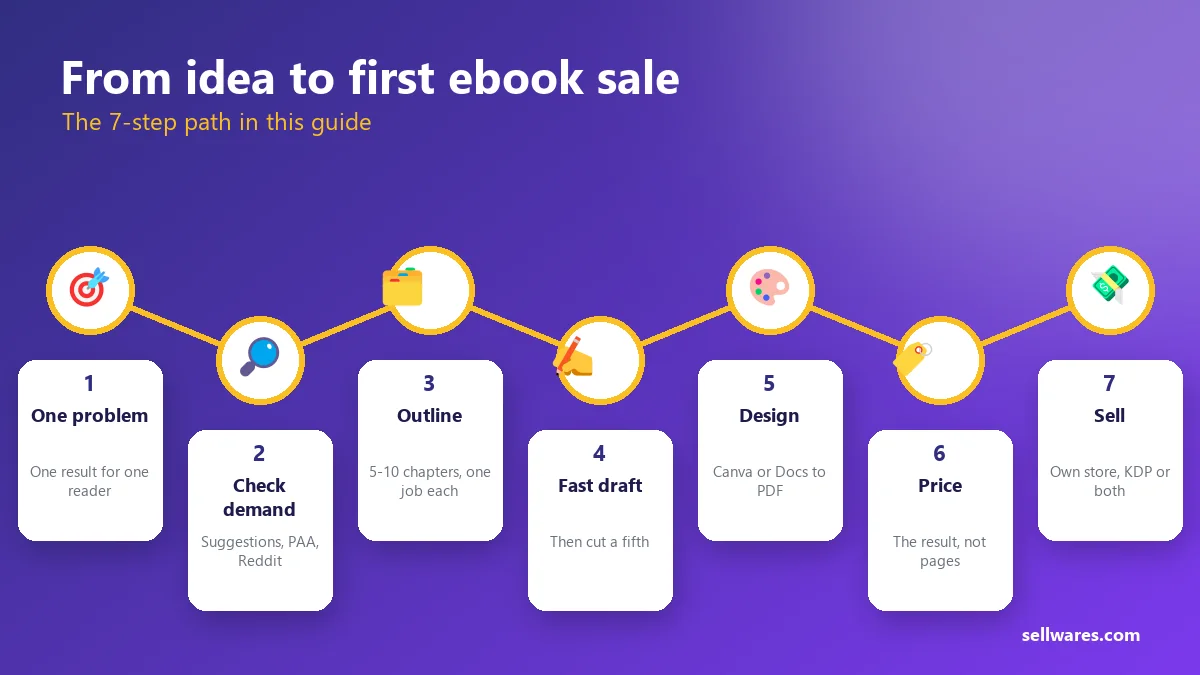
Whether you search for how to write an ebook, how to create an ebook or how to make an ebook, the process is the same seven steps:
- Pick one problem for one kind of reader.
- Check that people search for it.
- Outline 5 to 10 chapters, each one a step toward the result.
- Write a fast first draft, then cut it by a fifth.
- Design it in Canva, Google Docs or Word and export a PDF.
- Set a price that matches the result, not the page count.
- Sell it from your own store, on Amazon KDP, or both.
Step 1: Pick one problem for one reader
The ebooks that sell solve one clear problem for one clear person. "Healthy eating" is a library shelf. "A two-week lunch plan for night-shift nurses" is a purchase.
Start with the questions people already ask you. Look at your comments, your inbox and the replies to your posts. If you answer the same question every week, that answer is a product.
Write one sentence before you write anything else: This ebook helps [reader] get [result] without [pain]. Keep it in front of you. Every chapter must move the reader toward that result.
Step 2: Check that people search for it
An ebook nobody looks for needs you to find every buyer by hand. An ebook on a searched topic finds some of its buyers by itself.
Type your topic into Google and read the suggestions that appear. Scroll to the "People also ask" box and the related searches at the bottom. These are real questions with real demand. If you use a keyword tool, look for searches with steady volume and weak pages in the top results: forum threads, short posts and old articles. Those are topics where a better answer can still win.
Reddit is the other half of this step. Search your topic there and read the threads with the most comments. You will find the exact words your readers use, which become your chapter titles and your sales page.
Step 3: Outline 5 to 10 chapters
Do a brain dump first. Write every tip, story and mistake you know about the topic, one per line, without sorting.
Then group the lines into the steps a reader takes, in order. Most practical ebooks land between 5 and 10 chapters. Each chapter gets one job: a step, a decision or a fix.
A good outline for a short guide looks like this:
- Introduction: who it is for and the result they will get.
- Chapters 1 to 6: one step each, with an example.
- Checklist: the whole method on one page.
- Next step: what to do after they finish, such as your course, your coaching or your newsletter.
That last page matters more than it looks. It is where a $15 ebook turns into a $150 customer.
Step 4: Write a fast first draft
Write the draft in Google Docs or Word. Do not design while you write; it slows you down and you will redo it anyway.
Set a daily target you can keep, such as 500 words. At that pace a 10,000-word guide takes about four weeks. Write the chapter you know best first; momentum helps more than order.
When the draft is done, edit in three passes:
- Cut. Remove anything that does not move the reader toward the result. Most drafts lose a fifth here.
- Clarify. Short sentences, one idea per paragraph, examples instead of theory.
- Check. Every number, link and claim. One wrong fact costs more trust than ten typos.
How long should an ebook be?
As long as the result needs and no longer. Buyers pay for the outcome, not the page count. A tight 25-page guide that solves the problem sells better than a padded 120-page one, and it gets better reviews.
Step 5: Design it and export a PDF
You do not need a designer for a clean ebook. You need consistency.
- Canva has ebook templates. Pick one, change the colours and fonts to yours, and paste your chapters in.
- Google Docs or Word works for text-heavy guides. Use real heading styles so the PDF gets a clickable table of contents.
- Use one font for headings and one for text, wide margins and plenty of white space.
- Make a cover that reads at thumbnail size: a short title, big letters, one image.
Export a PDF for direct sales. PDFs open on every phone, tablet and computer. If you want to sell on Kindle, export an EPUB as well; Amazon converts it for Kindle readers.
Step 6: Price your ebook
Price the result, not the length. A guide that saves a small business owner ten hours a month is worth more than a novel-length overview.
A simple way to start:
- Under $10 for a broad, entry-level guide.
- $15 to $39 for a specific method with templates or checklists included.
- $49 and up when it comes with extras: spreadsheets, video walkthroughs or a community.
Then test. Raise the price after the first 20 sales if the reviews are good. Bundle the ebook with a template or a checklist to lift what each buyer spends.
Photo: Lala Azizli on Unsplash
Step 7: Sell your ebook and keep the most
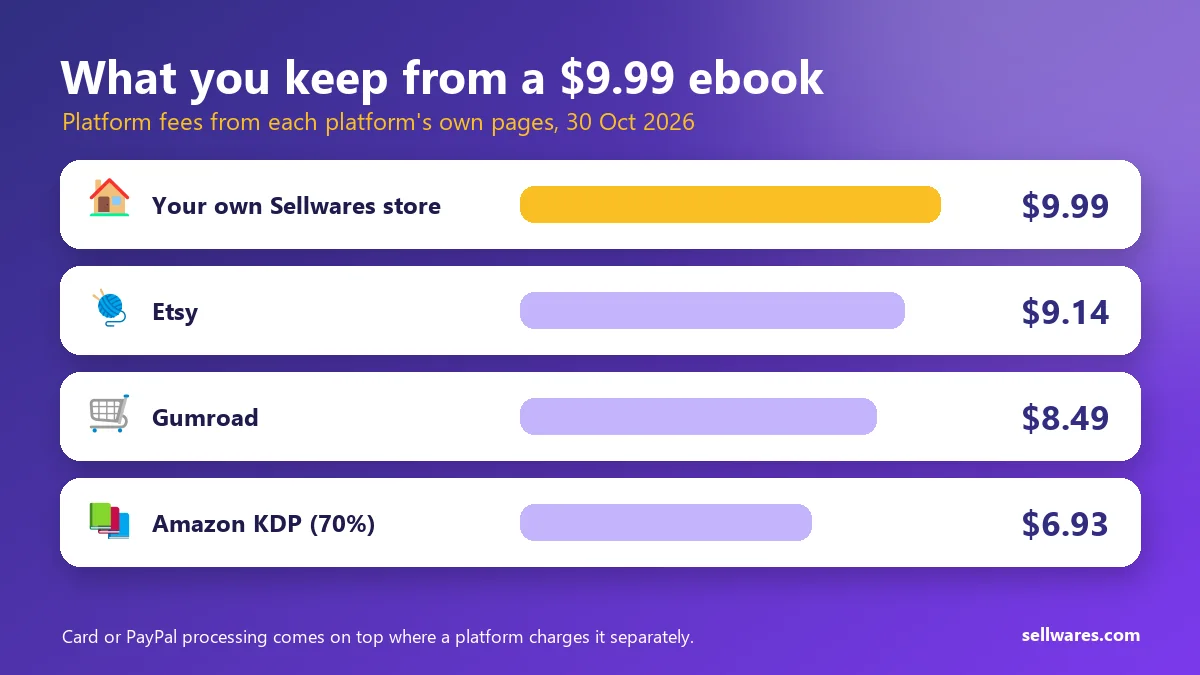
Here is what each common place to sell keeps from one $9.99 ebook sale, using each platform's own published fees.
| Where you sell | Platform fee on $9.99 | You keep | Who owns the customer |
|---|---|---|---|
| Your own Sellwares store | $0 (0% fee) | $9.99, minus your card provider's fee | You |
| Etsy | 6.5% + $0.20 listing | about $9.14, minus Etsy payment processing | Etsy |
| Gumroad | 10% + $0.50 | about $8.49 | Shared |
| Amazon KDP, 70% option | 30% + delivery cost | about $6.93 | Amazon |
Amazon's 70% royalty applies to ebooks priced between $2.99 and $9.99 in eligible countries, and a small delivery cost is taken per sale based on file size. Outside that range the royalty is 35%. Amazon brings readers who search its store, which is real value for fiction and broad topics.
For a practical guide sold to your own audience, your own store usually wins. You keep the whole price, the buyer's email is yours, and you can sell them your next product. On Sellwares the file is delivered the moment they pay, download links expire, and you can cap how many times each file is downloaded.
Many authors do both: Amazon for discovery, their own store for everything they sell to people who already know them.
Where to share the link
Put your store link in your link in bio on Instagram and TikTok, pin a post about the ebook, and mention it at the end of your best content. Give a free chapter away in exchange for an email, then tell those readers when the full book is ready.
What we found in the top results
We reviewed the pages Google ranks first for "how to write an ebook" on 30 October 2026. Three patterns stood out:
- Tools come first, money last. The top result is a design tool page. It shows how to make the file, not how to sell it.
- Forums rank on page one. A Reddit thread with 2 linking websites sits at #3. Real answers from real writers beat polished but generic articles.
- No fee comparison. None of the pages we checked shows what an author keeps per sale on each platform. That number decides whether an ebook is a side income or a hobby.
That is why this guide ends with selling. Writing the ebook is the part you control; choosing where to sell it is the part that pays.
Start with one small ebook
Your first ebook does not need to be your best work. It needs to exist, solve one problem and be easy to buy. Pick the question you answer most often, write the shortest guide that solves it, and put it on sale this month.
You can start a free store with up to 3 products and a 0% transaction fee, and add more when the first one sells.
Questions
How much money can you make from writing an ebook?
It depends on the audience more than the book. A focused guide sold to people who already follow you can earn steadily for years, because each extra sale costs nothing to deliver. Selling from your own store keeps the whole price; Amazon KDP pays 70% for ebooks priced $2.99 to $9.99.
What kind of ebooks sell best?
Practical guides that solve one specific problem for one kind of reader: step-by-step methods, workbooks, recipe collections for one diet, study guides and industry playbooks. Narrow topics beat broad overviews.
How many pages should an ebook be?
As many as the result needs and no more. Buyers pay for the outcome, not the page count. A tight 25-page guide that solves the problem often sells and reviews better than a padded 120-page one.
Do I need an LLC to sell ebooks?
Not usually. In many places you can sell as an individual or sole trader and register a company later. Rules on business registration and tax differ by country and state, so check your local requirements or ask an accountant.
Can I write an ebook for free?
Yes. Google Docs and the free version of Canva are enough to write, design and export a professional PDF. You can also start selling on a free store plan and pay nothing until you grow.