Product Ideas: 50 Digital Products You Can Sell Online
50 product ideas you can make and sell online, from templates and ebooks to courses and memberships, plus a 4-question test to pick the right one.

Good product ideas share one thing: they solve a problem people already pay to fix. Below are 50 product ideas you can make and sell online, grouped by type, with what each one is good for. Most are digital, because a file costs nothing to copy or ship, so a single afternoon of work can sell for years. Once you have picked one, our guide to selling digital products covers setup, pricing and fees.

Photo: Hanna Lazar on Unsplash
We put this list together after reviewing the pages Google ranks first for "product ideas" on 30 October 2026. They mix startup gadgets, Amazon listings and digital downloads, often without saying which suits whom. So every idea here says who it is for and what it takes to make.
Product ideas at a glance
| Type | Effort to make | Best for |
|---|---|---|
| Templates and planners | Low | Organised people, designers, spreadsheet fans |
| Guides and ebooks | Medium | Anyone with know-how people ask about |
| Creative assets | Low to medium | Photographers, designers, musicians |
| Courses and workshops | High | Teachers, coaches, experts |
| Services you can sell as a product | Medium | Coaches, consultants, freelancers |
| Memberships | Ongoing | Creators with a regular audience |
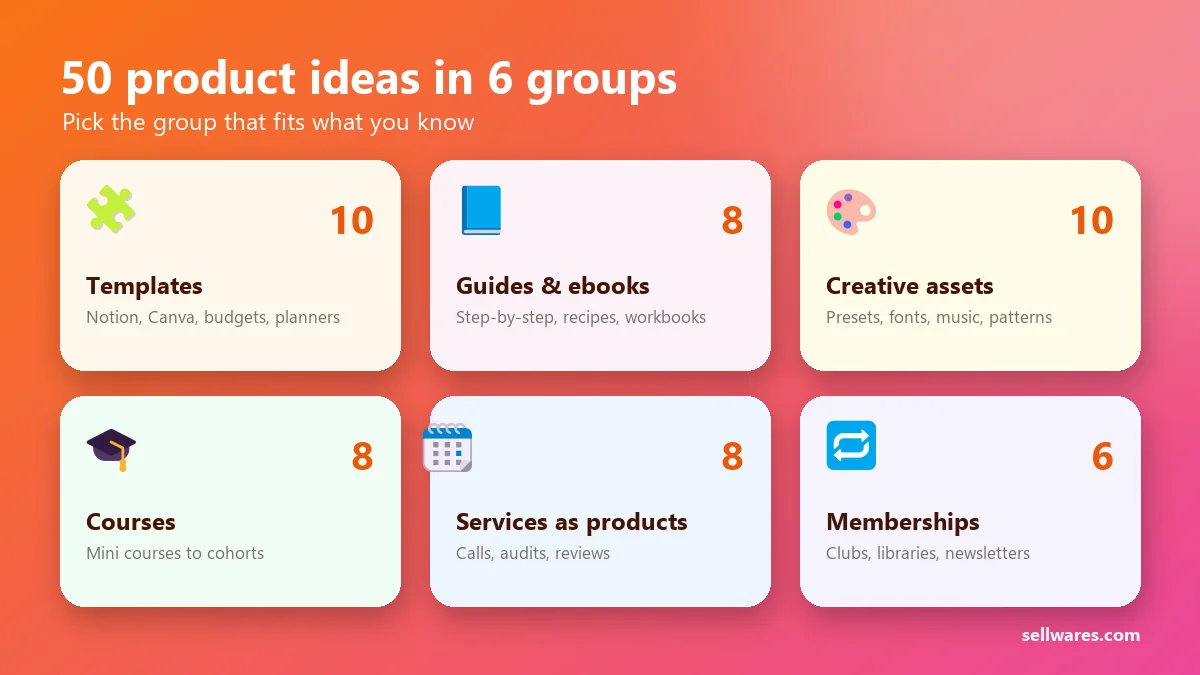
Templates and planners (1-10)
Templates sell because buyers pay to skip the setup. You build it once; they use it at once.
- Notion dashboards for students, freelancers or small teams.
- Budget spreadsheets in Google Sheets or Excel, with charts that fill in by themselves.
- Canva social media kits: post and story templates for one niche, such as real estate or fitness.
- Resume and cover letter templates for one industry.
- Digital planners for iPad apps like GoodNotes, with linked tabs.
- Printable planners and trackers: habits, meals, workouts, cleaning.
- Wedding and event planning kits with checklists and budgets.
- Business document packs: invoices, contracts, client onboarding forms.
- Content calendars with prompts for a full year.
- Pitch deck templates for founders and freelancers.
Guides and ebooks (11-18)
If people ask you the same question every week, the answer is a product. Our guide on how to write an ebook walks through it from outline to first sale.
- A step-by-step guide to one result, such as "pass your driving theory test in 14 days".
- Recipe ebooks for one diet or one situation: batch cooking, air fryer, budget meals.
- Travel guides to a city you know well, with your own maps and lists.
- Workbooks with exercises for goals, journaling or career changes.
- Industry playbooks: "how we got our first 100 clients" for a type of business.
- Study guides and exam notes for a specific exam.
- Parenting guides for one stage, such as sleep schedules or starting solids.
- Swipe files: collections of proven emails, captions or sales pages.
Creative assets (19-28)
Creative files sell to other creators who need them for their own work.
- Lightroom presets and video LUTs.
- Stock photos and video sold as themed packs.
- Fonts and hand-lettering sets.
- Procreate brushes and texture packs.
- Icon sets and illustrations for websites and apps.
- Music, beats and sound effects with clear licences.
- Printable wall art in standard frame sizes.
- Sewing, knitting and crochet patterns as PDFs.
- SVG cut files for Cricut and other cutting machines.
- 3D printing files for home, games or hobbies.

Photo: Andrijana Bozic on Unsplash
Courses and workshops (29-36)
Courses take longer to make but sell for more, because they lead someone to a result.
- A mini course: five short videos that solve one problem.
- A full online course with modules, quizzes and a certificate.
- A recorded workshop sold after the live event.
- A cohort programme with a start date and group calls.
- Software tutorials for a tool people struggle with.
- Language lessons for one situation, such as business English or travel phrases.
- Fitness programmes with weekly plans and videos.
- Creative skills: drawing, photography, video editing, music production.
Services you can sell as a product (37-44)
Selling your time as a fixed package with a price turns a service into something people can buy in one click.
- 1:1 coaching calls booked and paid on your page.
- Strategy sessions: one hour to plan a launch, a website or a career move.
- Audits and reviews: a resume, a portfolio, an online shop.
- Done-for-you templates customised with the buyer's brand.
- Office hours: monthly group Q&A calls.
- Mentoring packages of four calls over two months.
- Custom meal or training plans delivered as a PDF.
- Tarot, astrology or numerology readings delivered as a recording.
Memberships and recurring products (45-50)
Recurring products turn one-time buyers into monthly income.
- A paid community with monthly calls.
- A template club: new templates every month.
- A premium newsletter with deeper content than your free one.
- A recipe or meal-plan subscription.
- A sample or preset library that grows every month.
- A members-only course library that unlocks while they stay subscribed.
How to choose the right product idea
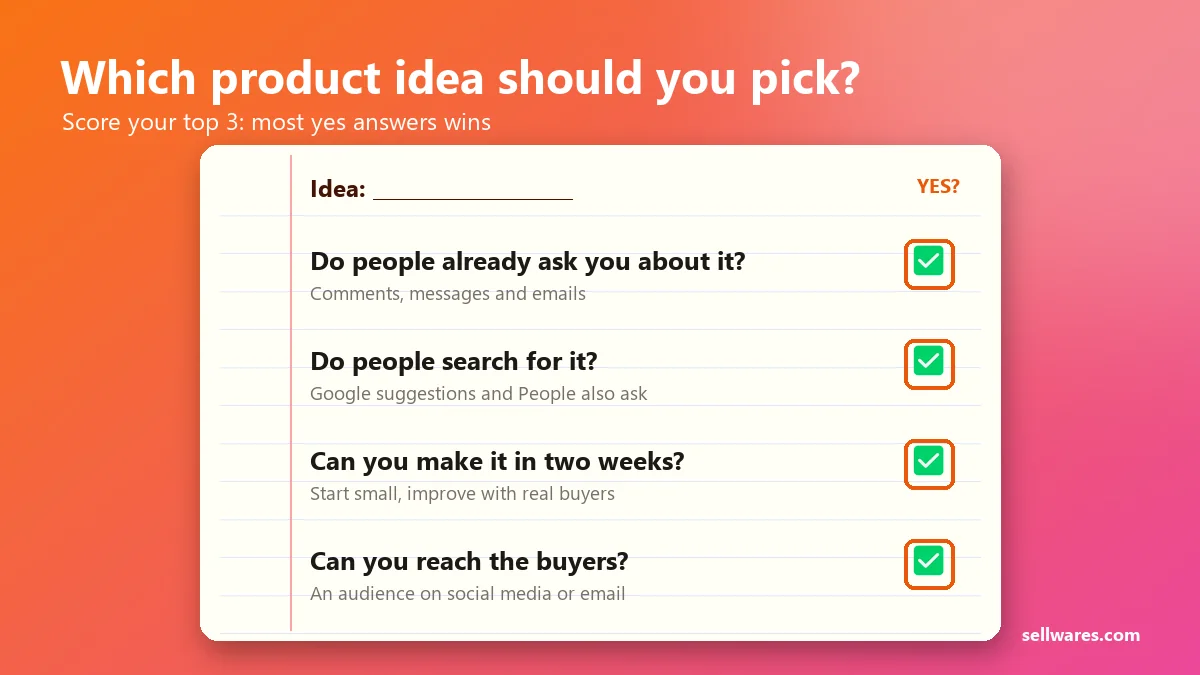
A long list is only useful if you can pick from it. Score your top three ideas on four questions:
- Do people already ask you about it? Comments, messages and emails are free market research.
- Do people search for it? Type it into Google and look at the suggestions and "People also ask".
- Can you make a first version in two weeks? Start small; improve after real buyers tell you what is missing.
- Can you reach the buyers? An audience on Instagram, TikTok, YouTube or email makes the first sales much easier.
The idea with the most "yes" answers wins. If two tie, pick the one you would enjoy making again.
How to validate a product idea before you build it
You can test demand before you make the whole product:
- Pre-sell it. Offer it at an early-bird price with a delivery date. Ten pre-orders is a strong signal.
- Give a free sample. A free chapter or mini template in exchange for an email shows how many people care.
- Ask your audience. A poll in stories or a question in your newsletter costs nothing.
- Look at competitors. Many reviews on similar products mean buyers exist.
What we found in the top results
We reviewed the pages Google ranks first for "product ideas" on 30 October 2026:
- Big lists win on links, not on usefulness. A LinkedIn article with 250 startup ideas ranks #2, but most ideas are inventions that need factories and funding.
- The page with the most traffic is a digital list. A Medium post of 50 digital product ideas, with just 2 linking websites, gets the most visits of the top 10. Readers want ideas they can start this month.
- Few pages help you choose. Lists rarely include a way to pick one idea, which is where most people get stuck.
Start with one idea this week
Pick one idea, make the smallest useful version, and put it in front of the people who already follow you. Your link in bio page is the simplest shop for a first product.
Open a free store with up to 3 products and a 0% transaction fee, and try your first idea this week.
Questions
What are some good product ideas to start with?
Templates, printables, short guides and preset packs are the easiest starts: low effort to make, nothing to ship, and easy to test with your audience.
How do I come up with a product idea?
Start with the questions people already ask you in comments, messages and emails. If you answer the same question every week, the answer is a product.
How do I validate a product idea before building it?
Pre-sell it at an early-bird price, give a free sample in exchange for emails, run a poll with your audience, and look for reviews on similar products. Ten pre-orders is a strong signal.
Which product ideas make the most money?
Courses, coaching and memberships usually earn the most per buyer, while templates and guides sell more often at lower prices. Many creators combine a low-priced product with a higher-priced one.